What the bank doesn't give you for the services that move your cargo
We're not another bank with a new name. We move each service payment faster, with one clear rate, and with people who know your trade behind every order. You keep your cargo moving; we make sure no stuck payment is the thing that holds up the ship.
Moving money for food businesses, corridor by corridor.
Including the ones the bank turns down.
Each service payment arrives complete, with one clear rate.
Checks and stays with your order from start to finish.
This is what we pay for you — the services that move your shipment
This page is for one thing: paying the actors that move your shipment — the freight, the forwarder, the customs broker, the broker, the commissions, the logistics operator. Not the supplier of the goods. You put the money in from your local account, and we get it to each service in their currency, in full. We work orders from 25,000 dollars, and each service gets paid the same business day or up to 48 hours, depending on the corridor.
Who pays which leg of the freight isn't improvised — it's set by a standard rule. Under the ICC Incoterms® 2020 rules, the split of costs between buyer and seller is listed in article A9/B9 of each rule (International Chamber of Commerce).
With each service paid on time, your cargo keeps moving and the ship sails — without a slow bank getting in the middle.
Why an international freight payment gets stuck at the bank
The deal is already closed. The cargo is ready, the route is booked, the agent is waiting. And still, the payments are the part that gets stuck — and there isn't just one. There are several, each one a different actor in a different country. These are the three walls a food business runs into again and again.
It's many payees, not one
A single shipment means paying the freight, the forwarder, the customs broker, and the agent's commission. Each one bills in their own currency, on their own terms, and the bank treats every one as a brand-new operation. The forwarder alone is the actor who ensures your goods move from origin to destination — booking carriers, comparing routes, handling the paperwork (FIATA). Miss one payment and the whole chain waits.
Freight already weighs on your margin, and the bank makes it worse
In the harder markets, moving cargo costs far more than in rich countries, wherever your business sits. On average, exporting the same goods the same distance costs 57 percent more for low-income countries than for high-income ones, and moving goods inside a low-income country costs about twice as much (World Bank). In Latin America the same weight shows up plainly: logistics runs between 18 and 35 percent of a product's value — and around 40 percent for small and mid-sized firms — against about 8 percent in OECD countries (Inter-American Development Bank). When the bank adds its own fees and a wide exchange rate on top of every service payment, that weight gets heavier.
The bank has no route to the service's country
Sometimes it isn't slow: there's simply no path. The forwarder, the carrier, or the agent sits in a corridor your bank doesn't clear, the same hard markets that trip up the goods payment. And the cost of moving cargo across those corridors is already a real, measurable slice of the value of the trade (ECLAC). When the bank says no to that corridor, every service on it waits with it.
More on paying the freight forwarder, the customs broker, the international broker, the logistics operator, and agent commissions is coming as its own page for each.
Who this is built for
Trilla moves trade-service payments from 25,000 dollars per payment and up. This is built for food businesses moving real volume — paying a freight invoice, a forwarder, a customs broker, a round of commissions — not for parcels or retail shipping rates. If your shipment costs run at that level, this is your path.
How you pay a freight invoice overseas, step by step
The path is the same for any actor on your shipment — freight, forwarder, broker, or commission. This is how you pay a freight forwarder, a carrier, or an agent abroad without the payment getting lost between banks and without the ship waiting on a stuck payment.

What makes one service payment cost more than another
Three things move the price: where the service is, which currency they bill in, and how fast you need it. A forwarder on a common corridor costs less to pay than an agent in a country the bank avoids. We give you one clear number before anything moves — what leaves and what lands — with no fine print. The bank's way is two hidden bites: a slice in fees and another in a wide exchange rate, on every single service. Ours is one rate you can see.
On terms: freight is often billed prepaid or collect, with net 30 or a 30-percent-up-front, 70-percent-before-shipment split. Whatever the term, you pay it on time from your own account.
A slice in fees
Another in a wide exchange rate
On every single service
One rate you can see, before anything moves
Your money moves; it never sits with us
Trilla moves your money — it never holds it. While a service payment is on its way, the money is only passing through, traveling along a safe, watched route to where it's going. It enters for your payment and goes straight out; it doesn't stop with us. Before each payment moves, we review the other side: the freight company, the forwarder, or the agent on the receiving end is a real business, checked just like you. That's one review, not a promise we can't make — we don't guarantee the corridor, we watch the money the whole way to its destination.
Payments we've moved lately
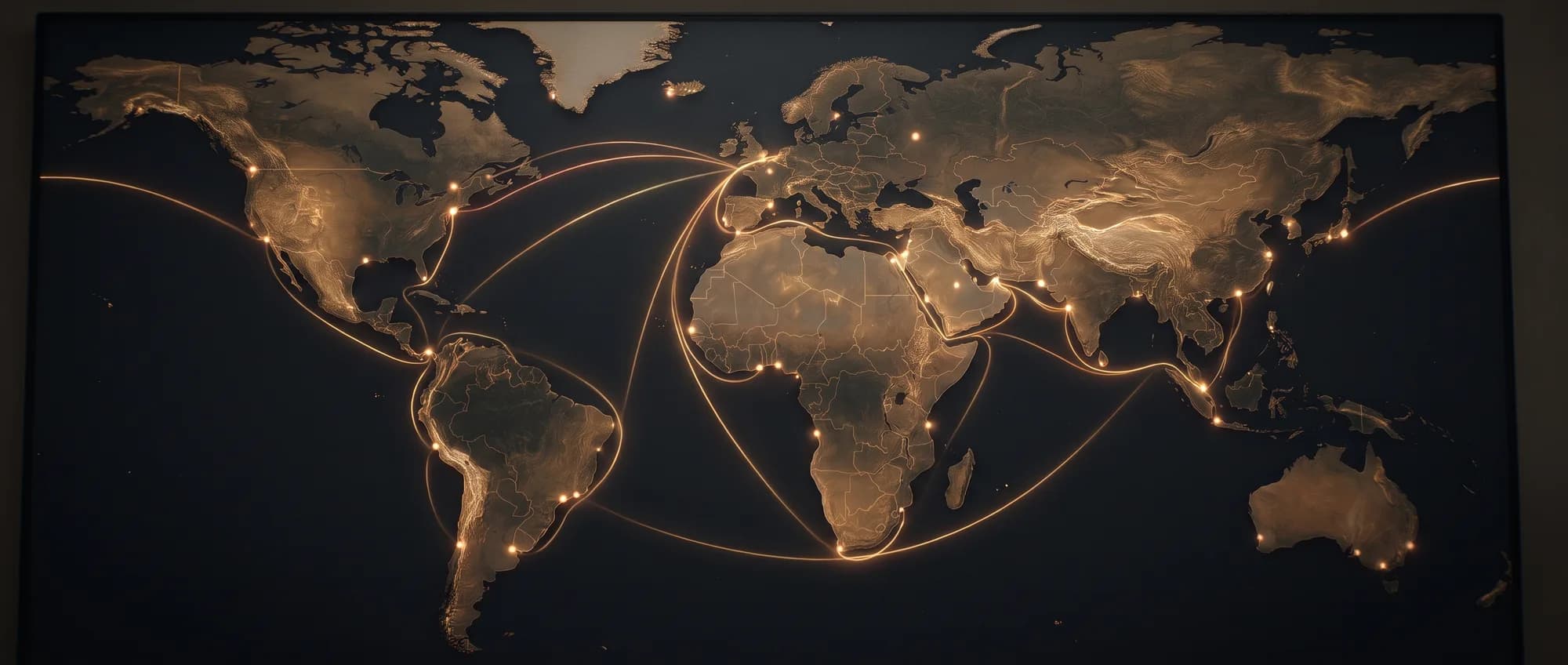
Real service payments we've moved for food businesses, shown as corridors — one a different actor, a different route, a different pinch.
The carrier billed in their currency and the booking wouldn’t hold without payment. The order went out from the local account and the freight was paid before the cut-off.
figure from approved set · pendingThe forwarder booked the route and handled the paperwork, then waited on a transfer the bank kept treating as new. One clear rate, paid in their currency, no second cut.
figure from approved set · pendingThe agent who closed the sale sat in a corridor the bank avoids. The commission landed in full, watched the whole way, in the agent’s own currency.
figure from approved set · pending
Every product moves its freight differently
Each product has its season, its urgency, and its own chain of services to pay. Perishable fruit can't wait on a stuck ocean freight payment the way a sack of grain can. Pay your freight and your agents on time, product after product:
Whether it's ocean freight for a bulk grain shipment or an air-freight agent for perishable cargo, the payment lands on time so the cargo doesn't sit.
If any of these sound like you, it's you
You import, and the freight and agents are the slow part
You move containers of food, and it’s not only the supplier you pay — it’s the freight, the forwarder, the customs broker. With those handled on time, your cargo never sits at the port waiting on a payment.
You export, and you pay your own freight
You sell abroad and you’re the one covering the shipping and the agents on your side. You pay each one from your local account, in their currency, without the bank dragging it out.
Your services sit where the bank doesn’t reach
Your carrier or agent is in a hard corridor, and every service payment was a fight. With Trilla as the route, the payment lands and the shipment moves.
Other paths your money takes
Paying the services of your shipment is one part. If your trade has more moving parts, we cover those too:
What food businesses ask us most
What is the best way to make an international freight payment?
The best way to make an international freight payment is from your local account, with one clear rate, paid in the carrier’s currency the same business day or up to 48 hours depending on the corridor. You place a payment order, the freight company gets paid in full, and you follow it until it lands — without the payment getting lost between banks.
How do I pay a freight forwarder abroad?
You place a payment order from your account telling us who to pay, how much, and in which country, and the forwarder gets paid in their own currency. It works the same whether you’re paying one forwarder or several services on the same shipment.
What are typical freight forwarder payment terms?
Freight is usually billed prepaid or collect, often on net 30 or a 30-percent-up-front and 70-percent-before-shipment split. Whatever the term your forwarder sets, you pay it on time from your local account, at one clear rate.
Do I pay the customs broker or customs directly?
You pay the customs broker their fee for clearing your cargo — that’s their service. The duties and taxes themselves go to customs, not to the broker, and on their own path. Trilla covers the broker’s fee, not the duty.
Can I pay all the services on one shipment in one place?
Yes — freight, forwarder, broker, and commissions can all be paid from your local account through Trilla, each in their own currency. You don’t need a different route or a different account for each actor on the shipment.
Why does the bank stall a freight payment?
Often the bank simply has no route to the service’s country, or treats the corridor as too much trouble, so a payment that should be simple gets a no. The banks that used to clear these payments have pulled back from the harder markets, which is why your freight or your agent abroad waits.